Investment proposal: Plan B, ~215M THB· Draft for discussion · October 2026
CNX Vinyl
A full-chain vinyl record plant for Asia-Pacific, in Chiang Mai, Thailand
Investment proposal: Plan B, ~215M THB, the launch plant with everything in. October 2026, draft. Plan A, the lowest-capital variant (~182M THB), appears only as the comparison.
~217M
THB at the midpoint (~6.56M USD), labelled ~215M: ramp-up reserve in, no contingency
0.58 to 0.90M
records a year at 60 % specials on three Newbilt presses est.
Whole chain
cutting, galvanics, stamper prep and pressing in-house from the first release
Simona Meesaiyati, Project Lead · Alexander Grabowski, Technical Consultant · supported by buildfor.life · label name Poy Records
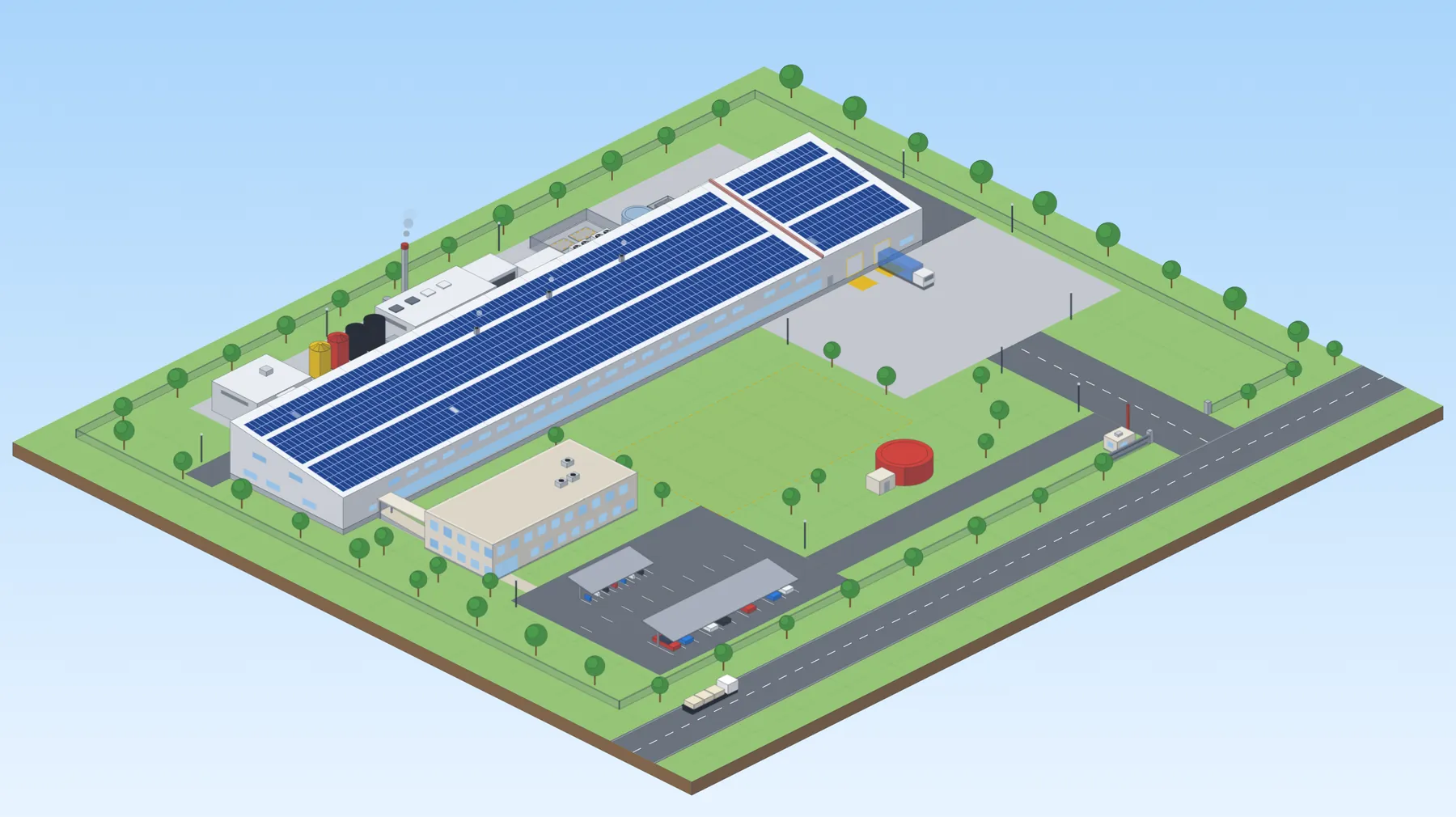
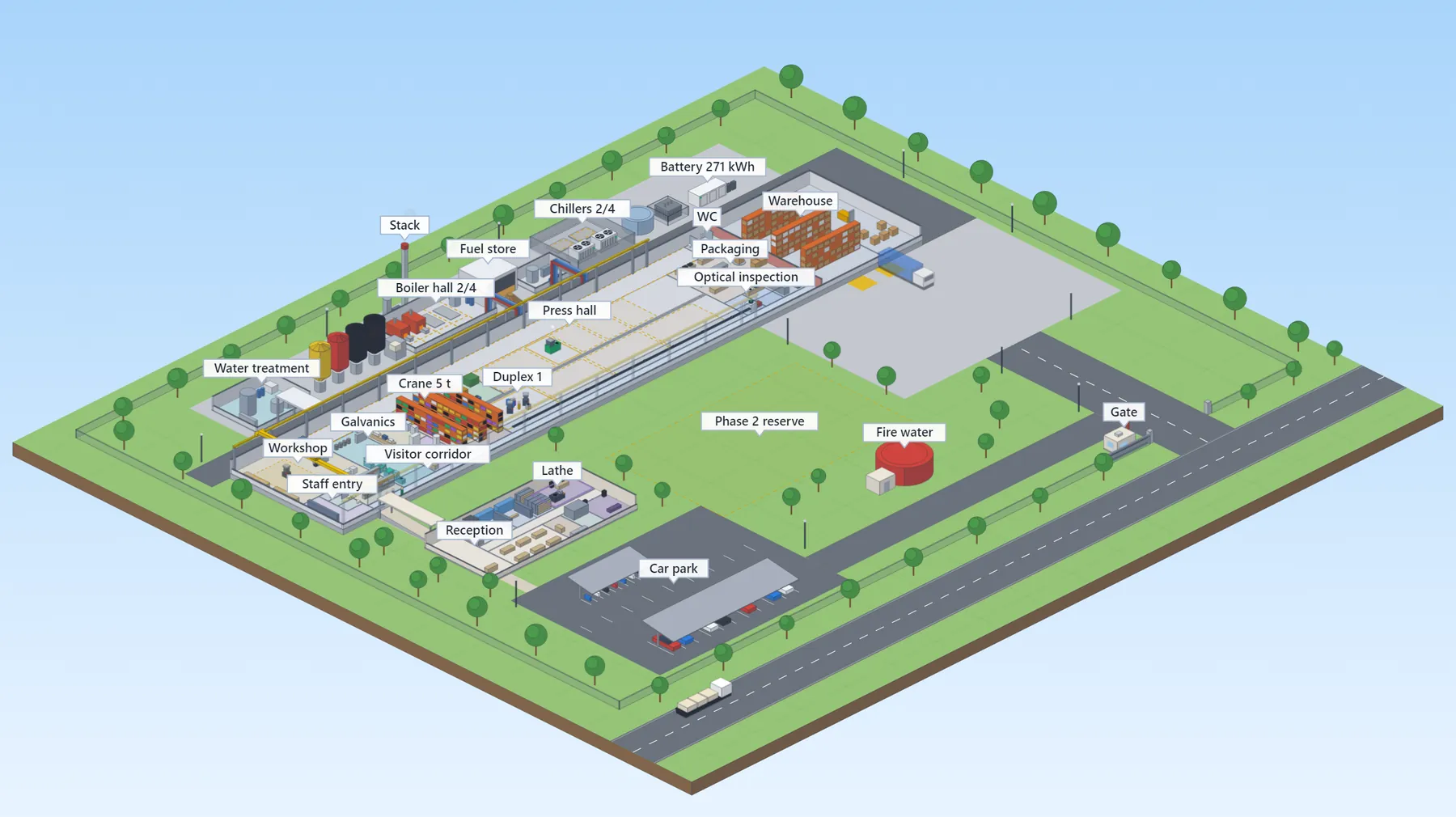
Plan B as the plant and business plan calculator draws it: the owned ~520 kWp array on the factory roof, office roof and canopies PV-ready. Schematic, on the Payap scenario layout and a placeholder plot; the site is not decided.
Source: business plan B, draft 0.3 (October 2026), cover and section 1; total-investment.md "Two plans". Render: fleet-calculator.html, Plan B preset (business plan B, figure 8). The price includes the 10M to 20M THB ramp-up reserve and carries no contingency.
The opportunity
Asia-Pacific labels press on other continents. We know of no full-chain plant in the region.
Where regional customers press today
Europe, the US, Japan
Labels in Southeast Asia, Australia and much of East Asia ship masters there, wait in those queues and pay freight and time zones on top.
10 to 16 weeks
roughly, for a standard black LP at European and US plants today, after 6 to 9 months at the 2021 to 2022 peak.
One shop
The one Thai pressing shop we have seen presses only: it buys its stampers abroad, has no climate control, and cannot economically serve runs under 300 units.
Price per record: the two market data points on file
Scopes differ. Europe: black pressing with printed labels and a paper inner sleeve at 300 copies. CNX: the plan's assumed price, USD 3.76 to 5.27, covering pressing, labels, inner sleeve and assembly at 60 % specials. Thailand: the per-unit price from the August 2026 invoices (650 to 950 THB all-in at 300), a printed jacket included; several times the CNX assumption even after 100 to 150 THB for the jacket.
What is still open
Market validation is open (roadmap item 1): no buyer prices yet. The Thai data is one buyer, one plant, one afternoon.
Making Vinyl Europe, Haarlem: strong supplier interest in full traceability. Supply-side evidence, not buyer validation.
The plan keeps its assumed price until buyers have been asked.
We compete on capability, not on price: in-house plating, climate control, metrology, traceability, short runs and represses from archived metal.
Source: business plan B, sections 1, 3.1 to 3.3 and 9.1; revenue-model.md "First market data point" and "Record Industry's calculator"; roadmap.md item 1. THB at 33 per USD.
What we build
The complete vinyl chain under one roof, bought in one capital round
1
Mastering
Console and chain; one to two engineers
2
Lacquer cutting
Sillitoe SDMS cutting system
3
Galvanics
Pheenix Alpha line; zero liquid discharge
4
Stamper prep
Sibert back-finish, punch, coin
5
Pressing
Newbilt Duplex system and Classic
6
Finishing
Trim, sleeve, shrink; optical QC
7
Packaging
Ploy Printing, Chiang Mai
8
Fulfilment
Bulk to labels, parcels to fans
3 presses
One Newbilt Duplex system (two semi-automatic HRP 12, EX 50 main and EX 35 colour extruder) and one Newbilt Classic, fully automatic
0.58 to 0.90M
records a year on two shifts at 60 % specials, central 0.74M est.; 0.71 to 0.97M at a standard-heavy mix
60 %+
special pressings: splatter, marble, colour effects. They run only on the Duplex, which sets the pace
Metal archive: the father and the mother of every side are kept, so a repress starts from our own metal: 2 to 3 weeks from an archived mother (planning figure).
Also from launch: cassette and CD-R duplication in-house. Full CD replication is a separate investor decision, outside the price.
Growth from revenue, not in the plan price: a second Duplex system lifts output to ~1.0 to 1.5M records a year; its floor, utility positions and pipe tees are reserved.
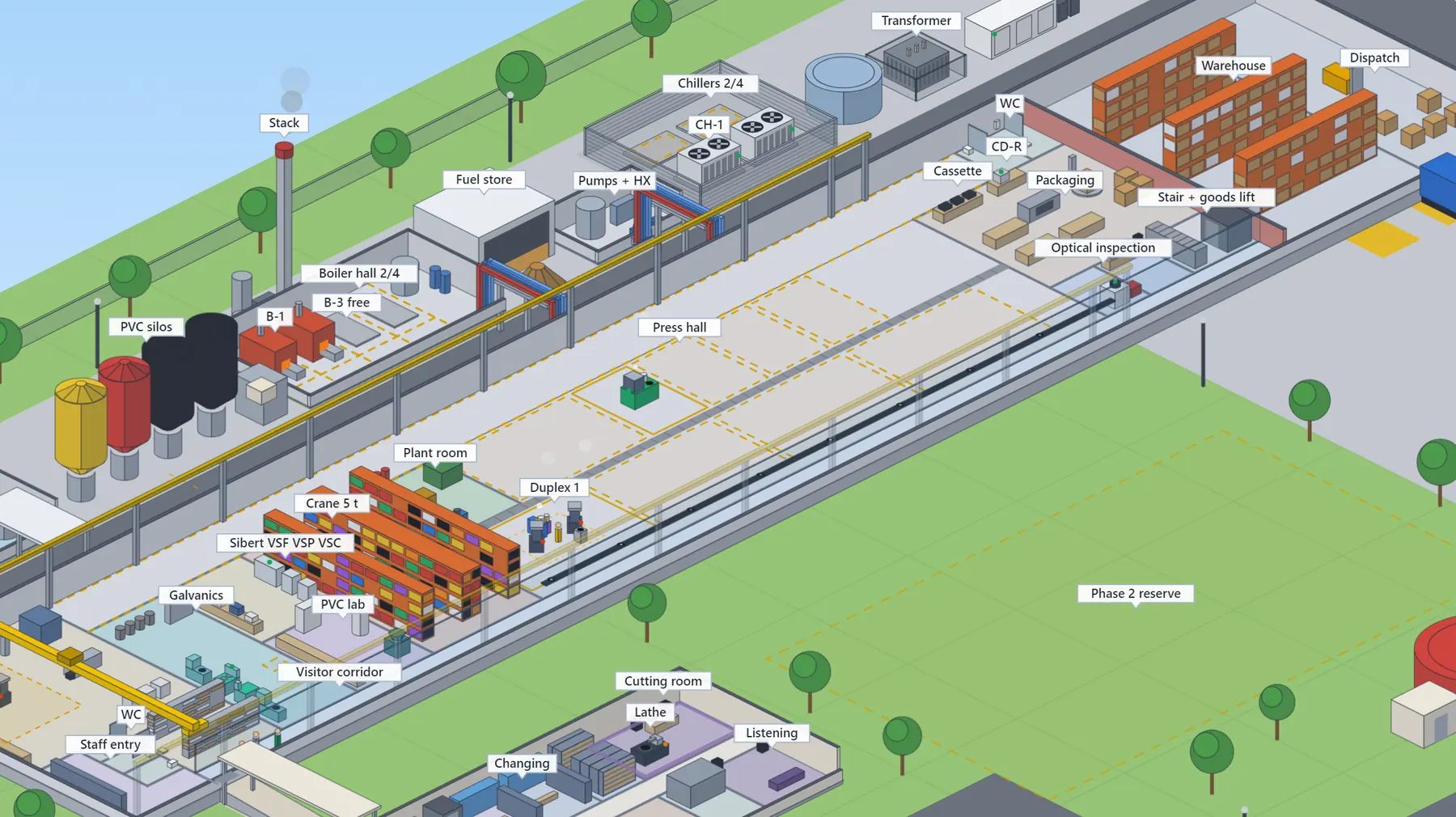
Press hall, Plan B preset: Duplex system 1 and the Classic, the 5 t crane, the visitor corridor and the cassette and CD-R rooms; dashed bays reserved for growth. Schematic (fleet-calculator.html).
Source: business plan B, sections 1, 4.0 to 4.4, 4.7 and 4.9, figure 10; total-investment.md "Launch plant"; scale.md; production-timeline.md; equipment/pressing-line.md.
How a record is made here
Nine stages, three artist approval gates, every record traceable
1
Audio intake
Checksums, format, technical QA
Gate 1 master plan
2
Vinyl mastering
Engineer QA of the vinyl master
Gate 2 master
3
Lathe cutting
Groove microscope, test cut, dead-wax scribe
4
Silvering, electroforming
Bath logs, XRF thickness per part
5
Stamper prep
Concentricity, dimensions, visual
6
Pressing
Telemetry per cycle, 100 % optical, sampled audio
Gate 3 test pressing
7
Finishing
Trim quality, sleeving
8
Packaging
Matrix code scanned against the jacket barcode
9
Fulfilment
Carrier tracking per shipment
Traceability
A record's key is stamper + press + cycle timestamp + side. Logs are append-only; a complaint resolves to one stamper, press, shift and material lot.
One system of record
ERPNext holds orders, gates, job cards, stock, inspections and metal-part genealogy; machine data sits beside it, keyed to the same names.
Layered quality control
Inline optical inspection of every record, press telemetry every cycle, sampled audio comparison against the master; a lab gate for every PVC lot.
Metrology and climate
Every stamper measured from the first release: XRF, laser confocal, wide-area profiler. The plant at 20 to 26 °C, 35 to 60 % RH, filtered.
100 %
of records through inline optical inspection
3 gates
artist approvals recorded before work continues
~10 sets
of stampers per archived mother; 5 to 10 mothers per father (rules of thumb)
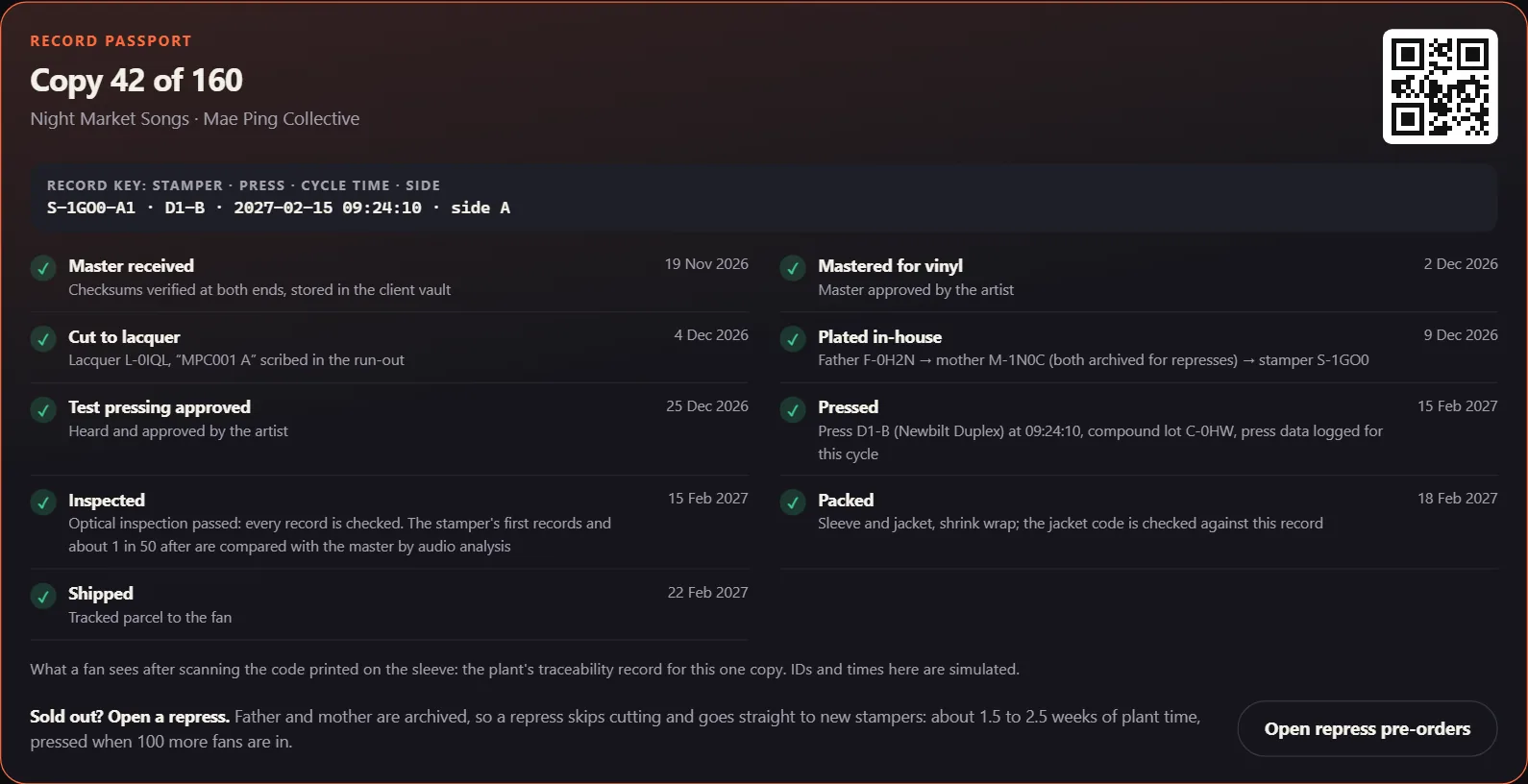
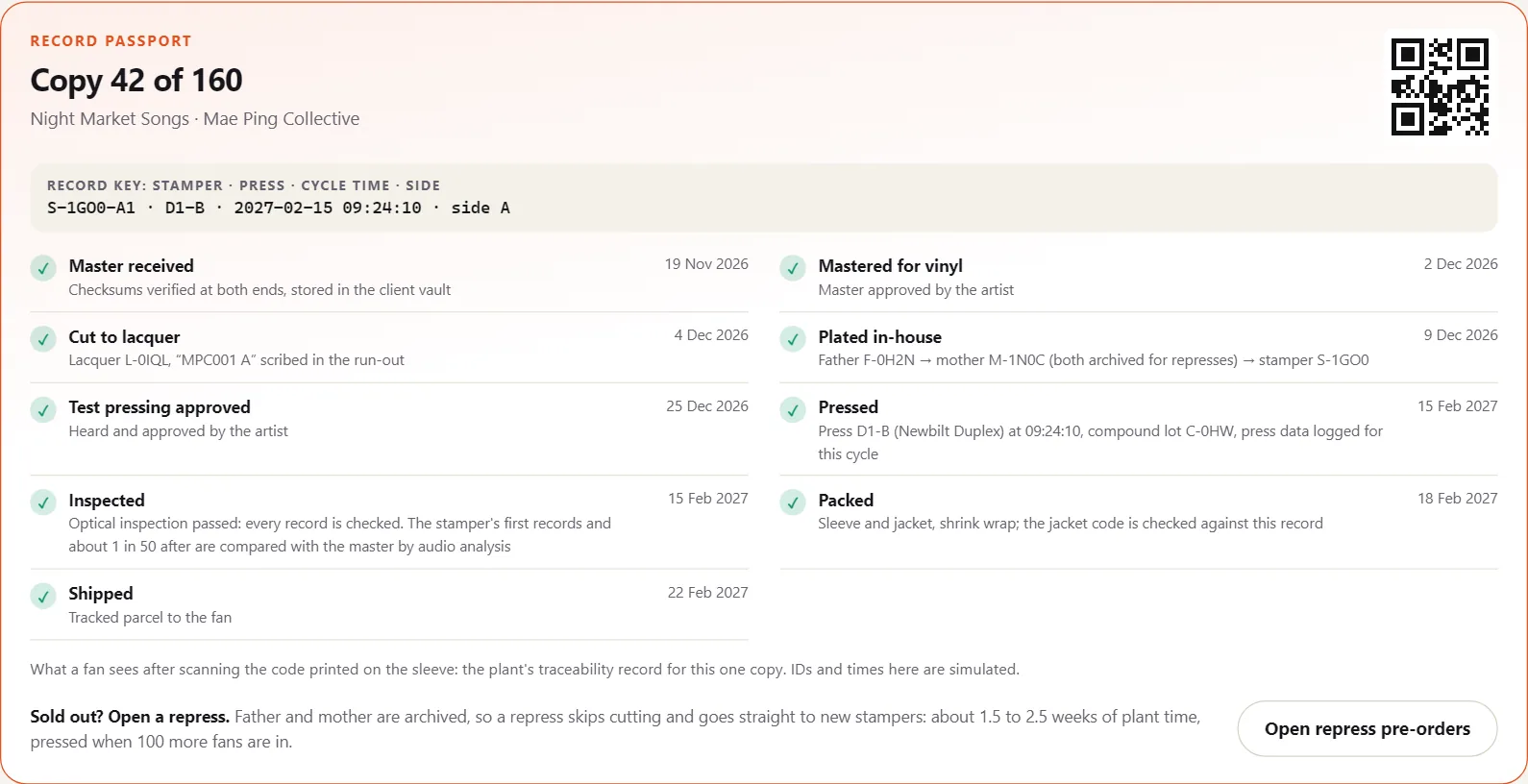
Record passport demo: what a fan sees from the code on the sleeve (IDs simulated, make-a-record.html).
Source: process-flow.md; traceability.md; quality-automation.md; digital-factory.md; business plan B, sections 1, 4 and 5.1 to 5.3.
The platform
One order tool: an itemised quote, or a pressing funded by fans
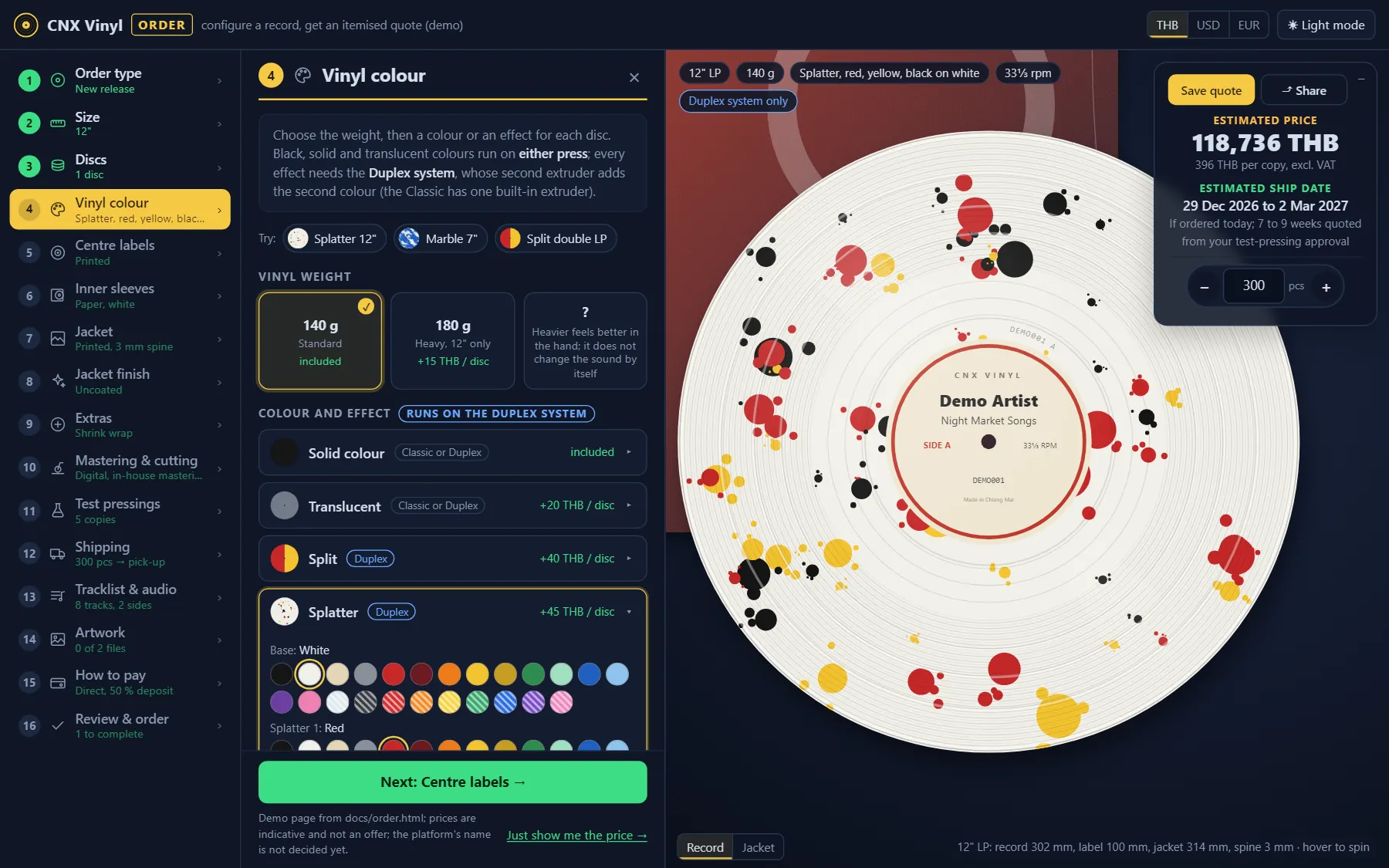
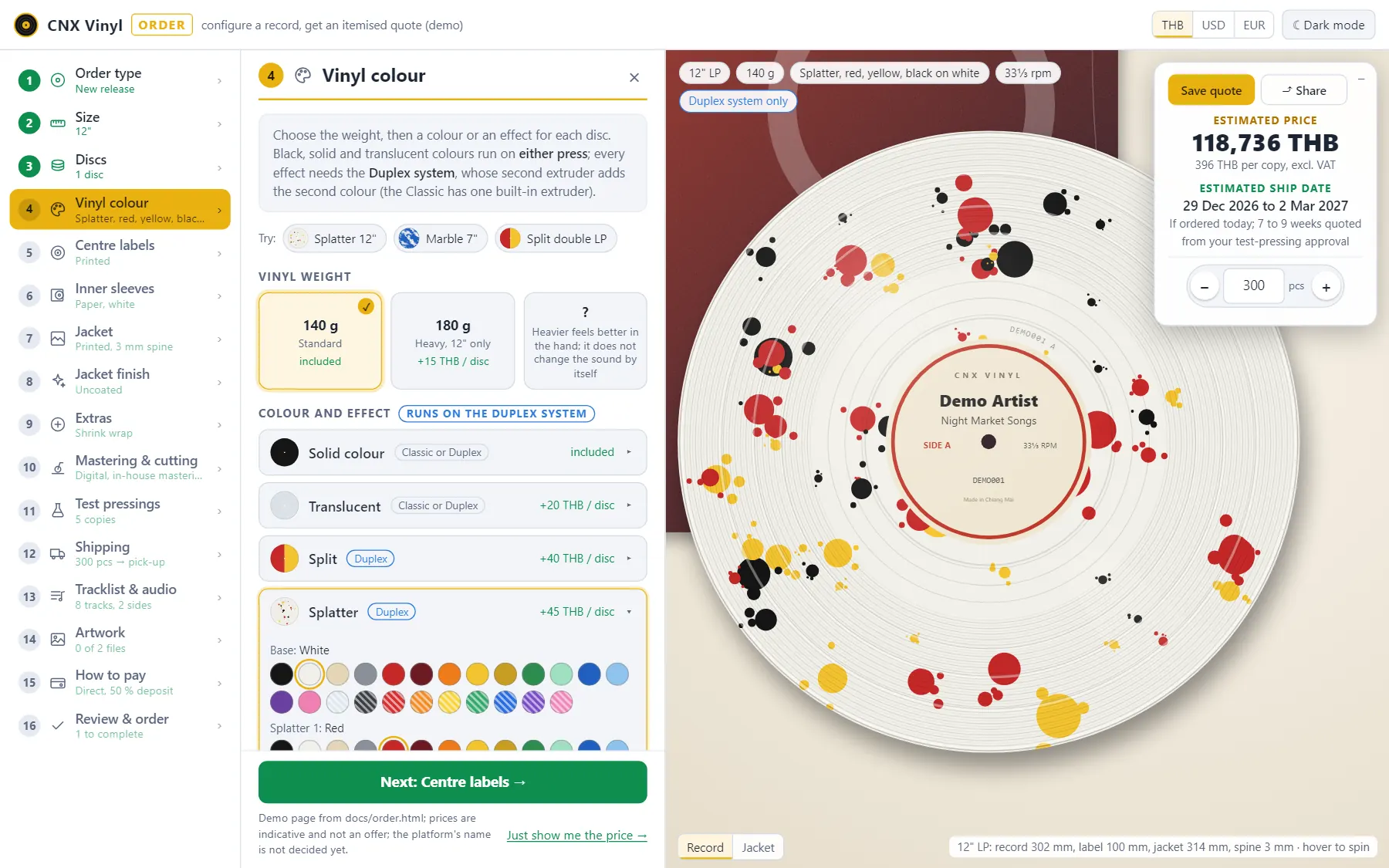
Step 4 with the "Splatter 12"" preset: the picture follows every option, the quote card every line. Prices and dates indicative, not an offer.
An itemised offer for every customer
Every line priced from one price list, per title and per copy, with audio and artwork checked at upload. ERPNext is the system of record: the order, the three gates and the invoice live there. Public early with indicative prices, so every configuration is market data.
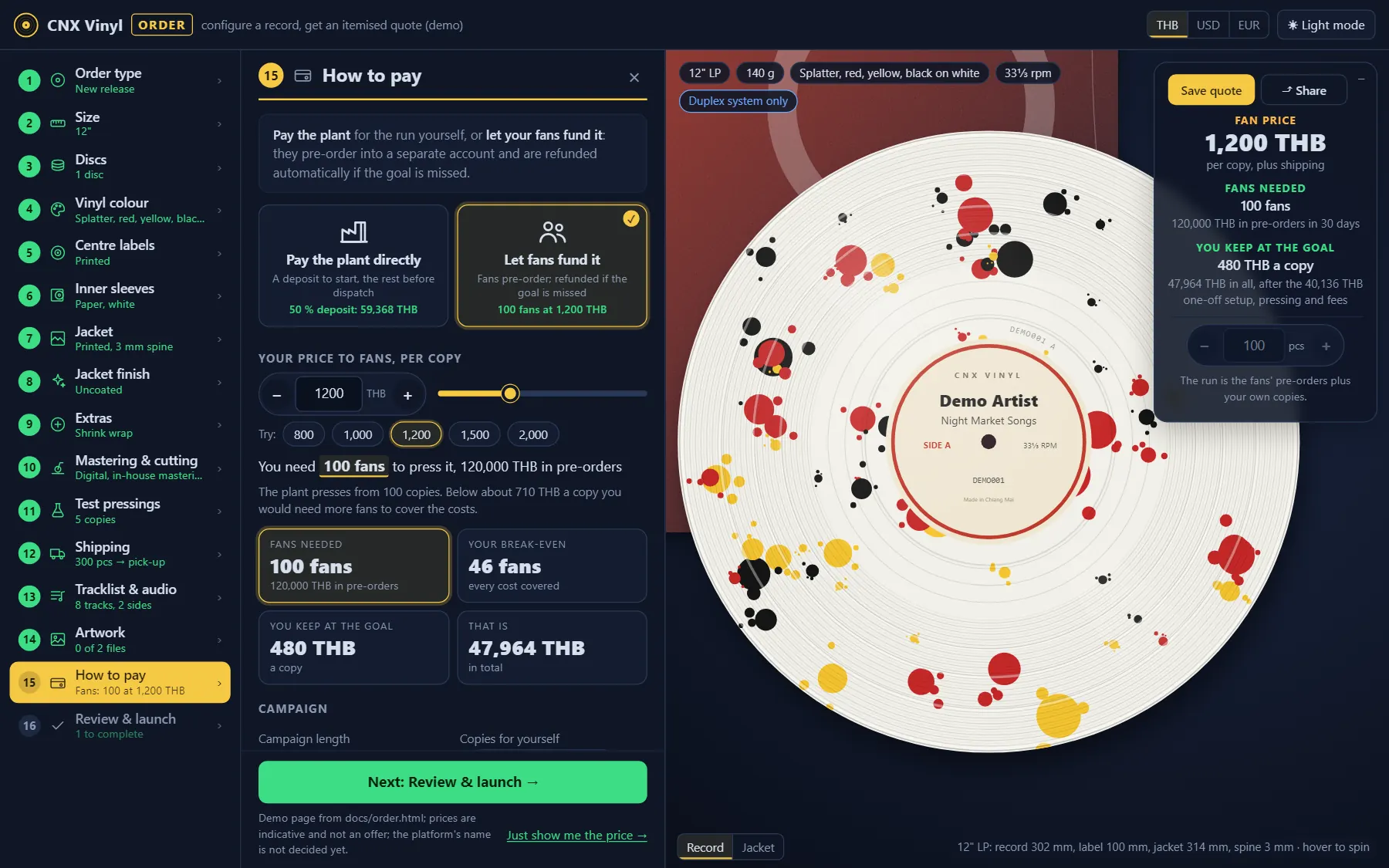
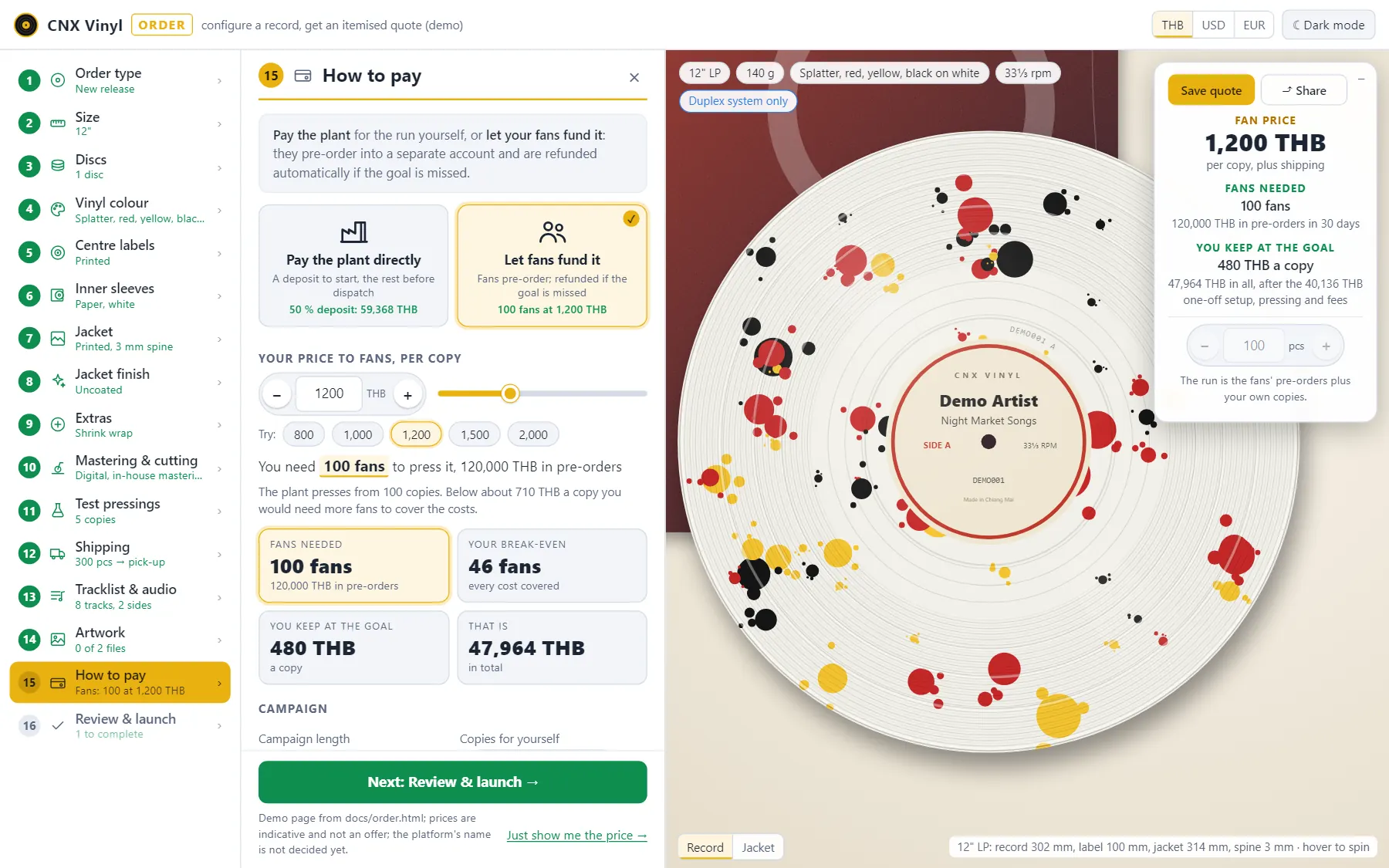
The same record funded by fans: at 1,200 THB a copy it needs 100 fans (break-even 46), and the artist keeps ~480 THB a copy after setup, pressing and fees. Indicative; the platform's name is not decided.
Fan-funded campaigns
Fans pre-order into a ring-fenced account and are refunded automatically if the goal is missed (the recommended model). The fans needed are the larger of break-even and the 100-copy minimum run, a planning figure. Campaigns open only after the first releases ship.
Source: artist-platform.md ("The goal", campaigns and payments); business plan B, sections 4.8 and 5.1; digital-factory.md "ERPNext: the plant's ERP". Screenshots: order.html, the step-by-step order tool (demo). Public side ~USD 40k to 90k est., inside the software block.
Site and building
A ~1,500 m² plant on leased land, utilities built for four modules
Ground floor with the roofs cut away, Plan B preset: galvanics, stamper prep, PVC lab, press hall, inspection, packaging and warehouse; the office with the cutting room; the 5 t crane, the visitor corridor and the 271 kWh battery. Schematic of the calculator's Payap scenario layout on a placeholder plot.
Site
Long lease. Working candidate Mueang Chi (Lamphun); still an option: Payap University land, ~5 km from Chiang Mai's old city, once rezoned (Payap says it can be; ~16 to 19 months est.). Industrial estate as fallback. Nothing signed.
Land
~4 rai minimum, 6 to 8 rai with expansion. Leasing keeps ~12M to 32M THB of land purchase out of the round; rent ~0.3M to 1.0M THB a year est.
Building
Steel portal frame, 60 × 25 m (1,500 m²), with its own 5 t crane; 30 kN/m² slab raised 1.2 m for dock-height loading; insulated, airtight.
Visitors
A glazed corridor in process order, built from the start: tours and the Payap programmes without stopping production.
Utility yard
~379 m²: boiler hall and chiller compound for four modules each. Launch: two 500 kg/h biomass boilers, two 250 kW chillers, Thai-supplied.
Roof
~520 kWp PV on the factory roof and a 271 kWh battery, owned est.; office roof and canopies PV-ready.
Growth
Duplex bays and utility positions reserved; a 45 × 38 m (1,710 m²) second building fits the Mueang Chi plot.
Source: business plan B, sections 6.1 and 6.2; site-candidates.md; scale.md; crane-workshop-tours.md; Payap rezoning: land-listings/payap/rezoning-2026-10-20.md (Town Planning Act B.E. 2562, section 35; the planning department's amendment work plan, ~70 to 82 weeks). Render: fleet-calculator.html, Plan B preset (figure 9). The 60 × 25 m hall is the Mueang Chi design; the layout is fixed once a plot passes zoning and lease-ability.
Sustainability, utilities and the region
Biomass steam, owned solar and zero liquid discharge, in the North
Steam from biomass
Two 500 kg/h modules on wood chips: ~0.67M THB of fuel a year against ~4.9M THB for electric steam, saving ~4.2M THB est. Grid demand ~264 kW instead of ~980 kW.
Heat recovered first: flue-gas economiser, condensate return, a heat pump lifting the presses' ~60 °C cooling return into feedwater.
Owned solar on the roof
~520 kWp
~730 to 780 MWh a year, ~87 % used on site: ~633 MWh, ~61 % of the plant's ~1,036 MWh est. Zero export on PEA's grid.
Owned, with the 271 kWh battery: ~2.3M to 2.5M THB a year off the power bill, payback ~4.1 to 5.8 years est.
Water and material
Zero
process water discharged
Closed cooling loop. Galvanics rinse water goes through a zero-discharge evaporator with metal recovery, in its own treatment building.
80 % virgin, 20 % regrind: edge trim and rejects are ground in-house and go back to the extruder.
Northern Thailand
~15 to 25
jobs across shifts at volume est.
Skilled roles in galvanics, cutting, QC and IT; Payap University programmes from day one through the visitor corridor (under discussion).
Chiang Mai, Lamphun and Lampang: the Northern Economic Corridor, promoted by BOI as a creative-economy base. Packaging from Chiang Mai.
Biomass brings fuel contracts, a monsoon stock, ash handling, a 14 m stack with a dust collector and a certified boiler attendant; the stack is a visible point source in Chiang Mai's burning season, so dust control is drawn from the start.
Source: business plan B, sections 1, 5.4, 8.4 and 12.1; biomass.md; sustainability.md "PV size with biomass steam" and "PV, not solar thermal"; boi.md "Regional angle"; scale.md. Fuel at ~850k records, planning price 1.35 to 2 THB/kg delivered.
Investment, Plan B
Plan B: ~217M THB at the midpoint, the launch plant with everything in
Plan B, block midpointlow to high end of the blockM THB est.
Plan B, the proposal
~217M THB ~6.56M USD
201.6M for the launch plant plus the 10M to 20M ramp-up reserve; ~156M to 277M from the low to the high end of every block. Labelled ~215M.
Plan A, the lowest-capital variant: the same plant with six cost levers~182M THB
What Plan B buys that Plan A leases or defers
In at launch in Plan B
Plan A instead
M THB
Solar ~520 kWp and 271 kWh battery, owned
Solar PPA
~14.7
Full metrology: confocal and profiler too
From revenue
~8.8
Visitor corridor and accessible entrance
Built later
~3.6
Cassette and CD-R duplication
Added later
~4.0
5 t overhead crane, bought
Rented
~3.2
Compressor from a Thai supplier
Chinese route
~0.25
Together, at the midpoint
~34.5
No contingency in the price (at 15 %: ~30M THB). Not in it: the central hydraulic plant, archive shelving, CD replication, financing costs, currency moves, duty and import VAT (BOI assumed).
Source: business plan B, sections 8.1 and 8.2; total-investment.md "Launch plant" and "Two plans". Block groups and their midpoints are arithmetic on the block ranges. Plan A: ~182M THB at the midpoint, ~132M to 233M low to high.
Why Plan B
Ownership and control, not a higher modelled return
Both plans build the same three presses and make the same records, so demand does not decide between them. The choice is ~35M THB more at launch for what Plan A leases or buys later, and fewer moving parts to finance once the plant runs.
~14.7M THB
No power contract on the roof
The ~520 kWp array and the 271 kWh battery are owned: no 15 to 25 year PPA and no ~1.9M THB a year PPA bill; the array pays back in ~4.1 to 5.8 years est.
~8.8M THB
Traceability from the first release
The laser confocal and the wide-area profiler at launch, not from revenue: every stamper fully measured, the core of the pitch to labels.
~3.6M THB
Tours and Payap from day one
A glazed corridor in process order for artists, labels, investors and schools, and the student programmes; cheaper to build in than to add.
~4.0M THB
Cassette and CD-R sales
Both formats sold from launch next to vinyl. Their revenue is not in the operating model.
~3.2M THB
Its own crane
A 5 t crane over the production compartment: machines moved in, out and around without hiring a mobile crane.
~0.25M THB
Local service
The compressor from a Thai supplier, like the rest of the utilities, instead of the Chinese route.
What the model says, Plan B against Plan A
Midpoints, estimates
Plan B
Plan A
Plan price, reserve in
~217M THB
~182M THB
EBITDA, central, revenue model
1.73M USD
1.73M USD
EBITDA, calculator: no PPA bill in B
2.23M USD
2.17M USD
Depreciation, central
0.49M USD
0.40M USD
Operating profit, central / adverse
1.24M / -0.55M
1.33M / -0.41M
Payback on the plan price, central
~3.8 yr
~3.2 yr
Cash payback and IRR, calculator
yr ~4.2, ~22 %
yr ~3.8, ~26 %
Read plainly: Plan A has the better modelled return, Plan B the more complete plant. Most of B's items could be added to A later from revenue; the corridor is cheaper from the start, and every year the array is leased costs the PPA bill. Owning the array earns no BOI tax benefit: solar was dropped on 1 July 2025, only the battery may qualify.
Source: total-investment.md "Two plans" ("What decides between them"); revenue-model.md "Operating pictures of Plan A and Plan B"; business plan B, sections 1, 8.2, 8.4 and 9.4; fleet-calculator.html, presets planA and planB; sustainability.md "Leasing instead (Plan A)" (PPA terms 15 to 25 years) and "PV, not solar thermal"; boi.md.
Operating picture, Plan B, mature year
Plan B's central case works; the adverse case loses money
RevenueEBITDAOperating profit, after Plan B's depreciationM USD a year
USD a year, Plan B
Adverse
Central
Favourable
Records
0.58M
0.74M
0.90M
Price per record
3.76
4.49
5.27
Direct cost per record
2.70
2.00
1.35
Revenue
2.28M
3.65M
5.41M
Revenue, THB
~75M
~120M
~179M
EBITDA
0.23M
1.73M
3.79M
Depreciation
0.78M
0.49M
0.29M
Operating profit
-0.55M
1.24M
3.50M
Payback, plan price
~37 yr
~3.8 yr
~1.2 yr
Read the adverse column as the honest one. A central EBITDA margin of ~47 % is far above the 15 to 25 % pressing plants earn: the direct cost leaves out indirect labour, freight, scrap above the reject allowance, sales commissions and the extra cost of specials.
~0.24M
records a year: break-even on operating profit
~1.1M
records the adverse case needs to cover depreciation; the presses make 0.58M
~2.8 USD
(~92 THB) a record covers depreciation at central cost and volume
Source: revenue-model.md "Operating pictures of Plan A and Plan B (October 2026)"; business plan B, section 9.4. Estimates, mature year at 60 % specials; depreciation on Plan B's blocks; payback is EBITDA on the plan price including the reserve. Plan A for comparison: operating profit -0.41 / 1.33 / 3.54M USD.
Cash and returns, Plan B
Ten years of cash: Plan B back to zero in year ~4.2, IRR ~22 %
Plan B, cumulative cashPlan A, for comparisonM USD, year 0 to 10
Calculator presets
Plan B
Plan A
Cash payback
year ~4.2
year ~3.8
IRR, ten years
~22 %
~26 %
NPV at 10 %
~4.7M USD
~5.4M USD
Year 0: investment and reserve
6.56M USD
5.52M USD
Mature-year EBITDA
2.23M USD
2.17M USD
Simple payback: plan price before the reserve / mature EBITDA
2.7 yr
2.3 yr
Basis: 850k records at 60 % specials at the team's planning rate (3 records a minute per Duplex system), the calculator's own cost build-up with biomass fuel and the cutting engineer; Plan B pays no PPA power price. Ramp 35, 70 and 90 % in years 1 to 3. Pre-tax, pre-financing, no BOI tax holiday, no terminal value: a sketch, not a forecast.
In the revenue model's adverse case, EBITDA pays Plan B's price back in ~37 years. A year-by-year cash model for the ramp is a phase 0 output.
Source: business plan B, section 9.4 and figure 12; fleet-calculator.html, presets planB and planA, cash view (values read from the page, October 2026); revenue-model.md. Estimates.
BOI promotion and financing
Duty-free machinery under BOI, debt-to-equity no higher than 3:1
Category
Basic plastic consumer-goods manufacturing (Category 6), incentive Group B: no tax holiday on the core activity. Sub-code to confirm with a BOI-registered consultant.
To confirm
Privileges
Machinery import duty exemption, with import VAT; 100 % foreign ownership; visas and work permits through the One Stop Service; raw-material duty relief for export production.
Group B core
Upgrades
Smart and Sustainable Industry (15/2565, refreshed July 2025): typically 3 years of CIT exemption, capped around 50 % of the upgrade spend; R&D merit at 1 % of revenue adds 1 to 3 years.
To structure
Solar
No longer promoted since 1 July 2025 (Announcement 3/2568): Plan B's owned array earns the bill saving, no tax benefit. The 271 kWh battery may still qualify, capped at 12M THB per MW.
Solar dropped
Conditions
Debt-to-equity no higher than 3:1 for the life of the privileges; minimum 1M THB excluding land and working capital; modern machinery; progress and annual reports; machinery imported within ~30 months, full operation by ~36 months.
Binding
Process
e-Investment filing and analyst meeting; ~40 working days to a decision under 200M THB, 60 to 90 above; 4 to 6 months in practice. No machinery order before the certificate.
Phase 0
Without BOI
~5 % duty on ~2.3M USD of imported machinery (~0.11M USD) and ~0.17M USD of import VAT up front est.
Avoided
Funding need, Plan B: reserve in, no contingency
~217M THB
~6.56M USD at the midpoint, labelled ~215M; ~156M to 277M low to high
~54M THB
equity at least: a quarter of the funding at the 3:1 ceiling (arithmetic)
Shareholding
At least 60 %the lead investor: at least ~32M THB
At most 40 %co-investors (Ploy Printing as intended strategic co-investor, the founders, others): at most ~22M THB
At the ~54M THB equity floor and one share price, arithmetic only: share price, valuation and in-kind shares not agreed. Terms in the shareholders' agreement.
Collateral
The machinery and equipment, in Plan B including the owned PV array and battery. The building only if the lease grants its ownership and the right to mortgage it. No land collateral: the site is a long lease of raw land.
Use of funds
Equipment (presses, metal path, metrology, lab) ~85M THB; building, crane, workshop and corridor ~40M; utilities ~35M; solar and battery ~15M; software, cassette and CD-R, freight, working capital and phase 0 ~28M (block midpoints est.), plus the reserve, in tranches (slide 16).
Financing structure to be agreed: no loan terms, interest rate or debt-service figures are on file.
Source: boi.md; business plan B, sections 1 ("The ask"), 6.1, 7.1, 8.1, 8.4 and 12.2; total-investment.md "Launch plant" and "Two plans" (shareholding, 20 October 2026). Equity floor, the 60/40 amounts and use-of-funds groups are arithmetic on the plan's figures, before financing costs.
Schedule
First paying release: Q4 2028 to mid-2029, and still open
Commissioning sequence
Cutting room and galvanics, with the Sibert line: the presses need their stampers.
Newbilt Duplex system, with boilers B-1 and B-2 and chillers CH-1 and CH-2.
Newbilt Classic, once the metal path and the press process are stable.
Alongside: cassette and CD-R lines. In the build: owned PV and battery, 5 t crane, visitor corridor.
Long-lead orders, after the certificate
Pheenix galvanics line, Sillitoe lathe, Sibert line, Newbilt Duplex system and Classic, two biomass boiler modules, the first two chiller modules. Press build 9 to 12 months, assumed; the other build times are not quoted.
What moves the date
The BOI filing date and the vendor build times: a 15 to 18 month press build moves launch to mid-2029. Ordering with a deposit before the certificate, if BOI allows it, could bring launch 6 to 9 months earlier.
Source: project-timeline.md, calendar anchored August 2026 (nothing in phase 0 has started, so it shifts day for day; not yet redrawn for the launch plant); business plan B, sections 10, 11 and 11.1; roadmap.md phases 0 to 4.
Risks and mitigations
The risks we carry, and what retires each one
Severity
Risk
Mitigation and status
High
Pricing power is unproven: market validation (roadmap item 1) is open, with no buyer prices yet
Validation gate with regional labels; the platform's calculator as an interest list; no large spending before it clears
High
Utilisation and price: the adverse case loses money; the extra cost of specials is not yet in the direct cost
Treat the adverse column as the honest one; specials gain an upper bound until compound quotes; second Duplex waits for demand
High
No contingency in Plan B's price: at 15 % ~30M THB; the high end of every block ~277M with the reserve
Quotes before commitment; release in tranches; how overruns are funded agreed up front
High
Galvanics and cutting on the critical path, galvanics the hardest skill to hire. Sibert advised getting presses, boilers, operators and feedback loops right first
Advice carried as a risk: commission the metal path first and measure it; hire early, train at the vendors; Stamper Discs and SST as overflow contacts
High
Prices not on file: the Newbilt Classic (placeholder band) and the Pheenix line (OMS reference + 20 %, no Pheenix quote)
Newbilt re-quote and Pheenix quote in phase 0; OMS's offer as the galvanics benchmark
High
Vendor build times unknown: the press build carries ~40 % of the schedule
Build time and order-book position required in every re-quote
High
Zoning unverified: Mueang Chi unchecked; Payap's first plot needs a rezoning (~16 to 19 months, Payap says it can be done)
Verify on the land-use map and with counsel before the BOI filing; industrial estate as fallback
Medium
Plan B's ~35M THB more than Plan A earns little in the model: payback ~3.8 against ~3.2 years, a deeper adverse case
Phase 0 prices each item against its lever (PPA offer beside the purchase quote); the corridor is cheaper from the start
Medium
Lease terms and building ownership: a weak lease makes the building hard to finance
Registered 30 to 50 year lease with renewal, building ownership and assignment rights; Thai counsel in phase 0
Medium
Galvanics effluent and biomass emissions in the first factory licence
Zero-discharge design and treatment building from the start; dust collector and 14 m stack drawn; fuel contracts
Medium
Currency: EUR on Newbilt and Pheenix, USD on Sibert and Sillitoe, costs in THB
Currency and validity in every quote; THB pricing regionally; hedging decided with the investor
Source: business plan B, sections 11.2 and 13 (severities as the plan states them); revenue-model.md "Honest caveats"; roadmap.md item 1; site-candidates.md.
Team, partners and vendors
A small founding team, specialist vendors and a local packaging partner
Team
Simona Meesaiyati
Project Lead
Management and the audio side.
Alexander Grabowski
Technical Consultant
The technical side: equipment and vendors, utilities, the building model, the traceability and QC specification, the factory software.
buildfor.life
Consulting
Supports the project in a consulting capacity.
To hire at launch: a galvanics process engineer and a cutting engineer (critical path), a plant manager, two shifts of operators, QC, maintenance, sales. About 20 people at the start est., plus 1 to 2 for the cassette and CD-R lines.
Partners
Ploy Printing
Chiang Mai · packaging
Jackets, sleeves and inserts; intends to co-invest within the 40 % open beside the lead investor, terms not yet discussed. Supply priced at arm's length, Ploy abstaining on its own contract.
Payap University
Chiang Mai · under discussion
Joint student programmes in mastering, lathe cutting, IT and business. Nothing agreed yet.
Advisers, phase 0
To engage
A BOI-registered consultant; Thai counsel for the lease, the company and the shareholder agreement.
Vendors
Vendor
Supplies
On file
Newbilt Germany
Duplex system and Classic presses
2024 quote EUR 200,500 for the Single 2.1, expired; Classic not priced
Pheenix Alpha Sweden
Galvanics: PASU, PPPU, PDPU, PMPB
No quote; priced at OMS's reference + 20 %
Sibert UK
Stamper prep: VSF, VSP, VSC
USD 250k budget confirmed, October 2026
Sillitoe Australia
SDMS cutting system
List price USD 125k
Ploy Printing Chiang Mai
Print and packaging
Partner
Making Vinyl Europe, Haarlem, 30 September to 2 October 2026: strong interest in full traceability; Pheenix offered references and a factory visit, OMS sent galvanics reference prices, SST Frankfurt offered help. Supplier-side evidence.
Source: README "Team"; business plan B, sections 1, 12.1 and 12.2; equipment/pressing-line.md; equipment/galvanics.md; suppliers/vendor-landscape.md.
The ask and next steps
Approve phase 0 now; commit to Plan B in tranches once the gates clear
Now: phase 0
1.3M to 2.6M THB
~USD 40k to 80k over 3 to 6 months, part of the plan price: the BOI consultant, Thai counsel for the lease, zoning and the shareholders' agreement, a soil test, the quotes.
On offer to co-investors
Up to 40 %
of the company, beside the lead investor's at least 60 %: Ploy Printing, the founders, others. Share price and valuation not agreed; terms in the shareholders' agreement.
Then Plan B at ~215M THB in tranches: share of the investment before the reserve est.
Fit-out, ZLD, owned PV and battery, crane, corridor, full metrology, software, cassette and CD-R
15 to 20 %
~30 to 40
4
Metal path commissioned; first stampers
Working capital; the reserve from here on
8 to 12 %
~16 to 24
The quotes that firm the numbers
Newbilt re-quote: Duplex with the EX 35, the Classic, build time
Pheenix galvanics quote, against OMS's reference
Sillitoe quote and build time; Sibert's itemised quotation
Building RFQ to two or three Thai contractors, with the soil test
Metrology quotes; solar and battery purchase quotes, a PPA offer beside them
Biomass boilers from Getabec and Chinese makers; fuel offers
Decisions for the investor
The equity and debt mix within 3:1 (equity at least ~54M THB)
The shareholders' agreement: the split of the 40 %, board, reserved matters and tranche releases
How quotes landing above the plan price are funded
Each Plan B item weighed against its lever; CD replication before the BOI filing; hedging of the EUR orders
Phase 0 unlocks
The BOI filing, the lease heads of terms and the zoning answer, and quotes in place of the estimated blocks: the next version of the plan.
The round unlocks
Every long-lead order and the build, commissioned in sequence: metal path, Duplex, Classic, with the owned PV, crane and corridor in place. First paying release Q4 2028 to mid-2029, open.
Revenue then funds
The second Duplex system (~15.4M THB at the midpoint est.), PV on the PV-ready office roof and canopies (~120 kWp, ~2.4M to 3.1M THB est.), the phase 2 building.
Source: business plan B, sections 8.3, 12.2, 14.1 and 14.2; total-investment.md "Two plans" (shareholding); roadmap.md phases 0 to 2. Tranche amounts are the shares applied to Plan B's ~201.6M THB before the reserve (arithmetic). Gates before any order: market validation, the BOI certificate, and land (zoning, lease terms, soil).